Not every kid is going to love my class. Obviously. Occasionally, however, something surprising happens. Sometimes an offhand comment pulls in the interest of my toughest cases. For example, today while discussing Christopher Marlowe and Sir Walter Raleigh one of my students (one the ones who "hates" my class) said: "Did you ever think how rich these guys would be now? I mean Shakespeare!"
Me: "Do you mean if they were still alive today after writing their work in the Renaissance or if they were modern writers and writing today?"
Student 1: "I don't know? Does it matter?"
Different Student (2): "I guess it depends on if you think their stuff is that good, that it would sell today."
Student 1: "Did Shakespeare write bad plays?"
Me: "Well not all of them are wonderful. Have you ever heard of Titus Andronicus."
All the Students: "No."
I then proceeded to give them a brief overview of the plot. The reactions were interesting. They were shocked that something like that went on the stage in the Renaissance, completely icked out, and wondering why we don't teach Titus instead of Hamlet.
Eventually we moved back to the day's lesson, but a couple of my boys who hate my class were talking as they walked out the door and trying to figure out if they could get copies of Titus our school library.
It was a fun moment.
Wednesday, January 22, 2020

Tuesday, January 21, 2020
A Good Mythology...
Myth is the basis for a lot of literature and not all of it fantasy. However in the realm of fantasy the ancient stories of heroes, gods, and goddesses provide a lot of inspiration. Some works are direct retellings such as Circe by Madeline Miller. Neil Gaiman recently published a retelling of Norse myths titled, appropriately, Norse Mythology. C.S. Lewis wrote a retelling of the Cupid and Psyche myth called Till We Have Faces.
Some books make use of the mythology but loosely. The most famous of these right now is probably Riordan's Percy Jackson series. However, Rick Riordan has several series based on various mythologies including Greek, Roman, Egyptian, and Norse. Holly Black has a number of books based loosely on Celtic mythology.
Still more are the books that borrow elements of real world mythology to flesh out a world of their own creation. In the case of Rowling's Harry Potter books, the mythology borrows from various mythologies while also providing a sort of unifying explanation for where the mythological critters came from and went. Many books rely on the stock fantasy races such as elves, giants, trolls, and dwarves. Each of these comes from a European myth group mostly Norse and Celtic.
So, any way, I guess my point is that mythology remains relevant to our literature
Some books make use of the mythology but loosely. The most famous of these right now is probably Riordan's Percy Jackson series. However, Rick Riordan has several series based on various mythologies including Greek, Roman, Egyptian, and Norse. Holly Black has a number of books based loosely on Celtic mythology.
Still more are the books that borrow elements of real world mythology to flesh out a world of their own creation. In the case of Rowling's Harry Potter books, the mythology borrows from various mythologies while also providing a sort of unifying explanation for where the mythological critters came from and went. Many books rely on the stock fantasy races such as elves, giants, trolls, and dwarves. Each of these comes from a European myth group mostly Norse and Celtic.
So, any way, I guess my point is that mythology remains relevant to our literature
Sunday, January 19, 2020
Week 3 1/19/2020 - 1/25/2020
As predicted, a second crazy week. This one was a bit more of a grind. Sometimes it feels like the kids come back extra crazy and it's just wears one down. As sure as I was that I'd blast right through Dreyer's English and move on to catch up with my pacing, I ended up stuck for almost six days in it. I managed to wedge in another before the end of the week, but it's making me look at my reading pattern. I used to read a lot of YA (still do really, but less than I used to). I can get through most YA novels in about a day on a weekend, two days if it's a school day or if it is particularly long or difficult for some reason. At that rate I'd be aboutle to read 200 books easily if I didn't need occasional time off for brain realignment.
When I read non-YA, it takes significantly longer to get through each book. I'm averaging about two books a week of non-YA. It's still a respectable number and I'll easily manage 100 books in the year, but it's not what I'm aiming for. It's possible that I will get faster on the non-YA as I read more, but I suspect I'm going to need to do some serious balancing to stay on track.
In planning for the next week, I deliberately added in a couple that I thought would be quick reads. I'm hoping to make up some ground, but I want to keep including the non-YA.
When I read non-YA, it takes significantly longer to get through each book. I'm averaging about two books a week of non-YA. It's still a respectable number and I'll easily manage 100 books in the year, but it's not what I'm aiming for. It's possible that I will get faster on the non-YA as I read more, but I suspect I'm going to need to do some serious balancing to stay on track.
In planning for the next week, I deliberately added in a couple that I thought would be quick reads. I'm hoping to make up some ground, but I want to keep including the non-YA.
Half World by Hiromi Goto(Finished 1/9/2020)- Black Leopard Red Wolf by Marlon James
- Peter Porker, The Spectacular Spider-Ham: The Complete Collection Vol 1
- The New Complete Joy of Home Brewing by Charlie Papazian
- Delta-V by Daniel Suarez
- Where Do You Get Your Ideas? by Fred White
Saturday, January 18, 2020
Finished my reread...
...and I'm suddenly worried about introducing it as a class text. I still believe in the importance of the book and every reason I said we should do this. However, I'm also seeing every reason it could be challenged. I'm sure it's going to be a good experience, but I have to admit that I'm a little daunted.
So that's what I've been doing all day since finishing the reread: avoiding thinking about the task very quickly coming up.
It'll be good.
I'm sure it will.
Really.
So that's what I've been doing all day since finishing the reread: avoiding thinking about the task very quickly coming up.
It'll be good.
I'm sure it will.
Really.
Friday, January 17, 2020
Rereading...
I don't get to reread books very often. There are so many books out there and so much to read that I generally reach for something new over an old favorite. The one exception are the texts that I teach. I've read Hamlet something like 20 times, for instance. Because how teaching curriculums work, I don't get to add new texts to that rarified list very often. This year though, I'm adding a new book to my freshman class namely The 57 Bus by Dashka Slater. In preparation for this, I'm rereading the book.
Rereading is a very different experience than discovering a book for the first time. There's no thrill of discovery here. There is no urgency to find out what happens next, yet the reading often goes faster. When rereading is when I start to notice, really notice, how the language fits together. I spend more time looking for hints and foreshadowing. Over time, and multiple rereads I can see how authors build character investment.
It is, in its own way, just as satisfying as reading a book for the first time. I should do more rereads.
Rereading is a very different experience than discovering a book for the first time. There's no thrill of discovery here. There is no urgency to find out what happens next, yet the reading often goes faster. When rereading is when I start to notice, really notice, how the language fits together. I spend more time looking for hints and foreshadowing. Over time, and multiple rereads I can see how authors build character investment.
It is, in its own way, just as satisfying as reading a book for the first time. I should do more rereads.
Thursday, January 16, 2020
Dreyer's English: An Utterly Correct Guide to Clarity and Style by Benjamin Dreyer
(This one gets its own post, owing partly to how aggravatingly long it took me to read.)
My dad bought me this for my birthday (which is in July) I think partly because I'm an English teacher and partly because I have an annoyingly difficult time with grammar. Truly, I want things to make consistent sense and English grammar just doesn't. I have made my peace with that (mostly) and commiserate (often) with my students over this.
I walked into this week thinking that this relatively small tome (for an English usage guide) would only take me a day or so to finish. I was wrong. It's Thursday; I just finished. Feh. So how did this happen? How did I let a sub-300-page book take me six days? I have only one explanation:
It's damn funny.
Seriously, who reads a grammar and usage text and . . . giggles. I've been giggling all week. Annoyed, yet amused. Ryan reminds me that at its core, this is a book of lists; annotated lists. That's true. Generally, one doesn't read a style book cover to cover. (You look for whatever arcane rule you need, and move on with life.) I think Dreyer wrote this with the idea of people reading it as a complete work, yet it is, at the core, an annotated list of grammar and usage rules which is why it took me so long to slog through.
It would also work very well as a reference text. (I'm not sure that's a compliment.) It is hilarious. (That one was a compliment. . . just checking) It's tough to read straight through. (You decide.)
Ok, really. If you've ever been frustrated with the seemingly contradictory rules of English usage and grammar, even for a moment, this is the text for you. Dreyer is remarkably unstuffy about an incredibly stuffy subject. While I commit many grammatical sins, reading this made me feel justified in a few of them. There are few actual rules in English. The rest is convention. I've suspected this for years; it's nice to have it confirmed.
This is good stuff.
Read the stuff.
Read it.
My dad bought me this for my birthday (which is in July) I think partly because I'm an English teacher and partly because I have an annoyingly difficult time with grammar. Truly, I want things to make consistent sense and English grammar just doesn't. I have made my peace with that (mostly) and commiserate (often) with my students over this.
I walked into this week thinking that this relatively small tome (for an English usage guide) would only take me a day or so to finish. I was wrong. It's Thursday; I just finished. Feh. So how did this happen? How did I let a sub-300-page book take me six days? I have only one explanation:
It's damn funny.
Seriously, who reads a grammar and usage text and . . . giggles. I've been giggling all week. Annoyed, yet amused. Ryan reminds me that at its core, this is a book of lists; annotated lists. That's true. Generally, one doesn't read a style book cover to cover. (You look for whatever arcane rule you need, and move on with life.) I think Dreyer wrote this with the idea of people reading it as a complete work, yet it is, at the core, an annotated list of grammar and usage rules which is why it took me so long to slog through.
It would also work very well as a reference text. (I'm not sure that's a compliment.) It is hilarious. (That one was a compliment. . . just checking) It's tough to read straight through. (You decide.)
Ok, really. If you've ever been frustrated with the seemingly contradictory rules of English usage and grammar, even for a moment, this is the text for you. Dreyer is remarkably unstuffy about an incredibly stuffy subject. While I commit many grammatical sins, reading this made me feel justified in a few of them. There are few actual rules in English. The rest is convention. I've suspected this for years; it's nice to have it confirmed.
This is good stuff.
Read the stuff.
Read it.
Tuesday, January 14, 2020
Stuck in the doldrums
It is possible in reading, to like a book but be stuck in it. I'm in the middle of Dreyer's English and I love it. It makes me giggle...about grammar. Yet, I just feel like it's taking too long to read and I'm getting restless. I guess tomorrow I'll either finish it or start a second book.
Ok.
Back to reading

Ok.
Back to reading
Monday, January 13, 2020
On the Subject of Head Colds
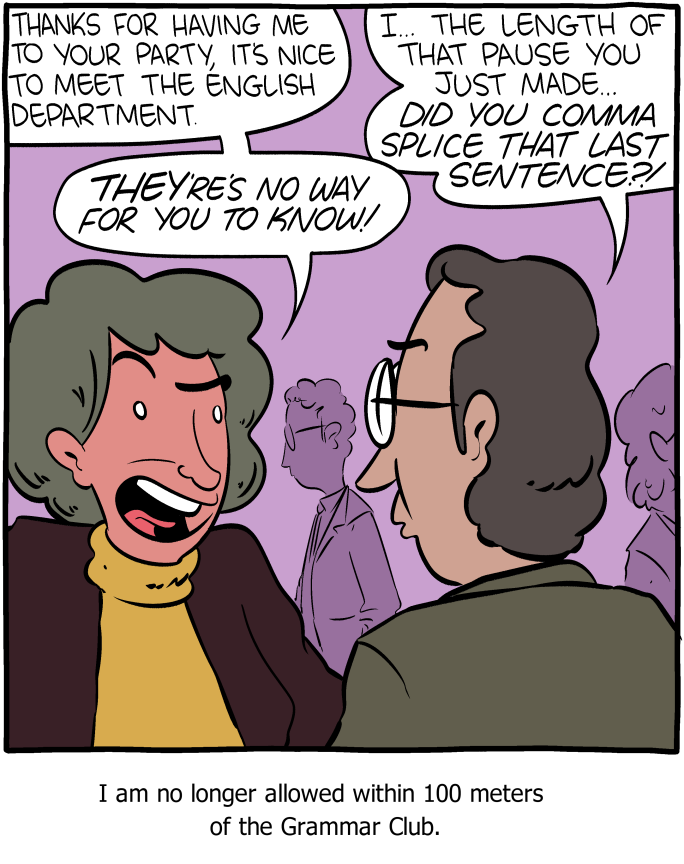
I hate head colds because it makes everything surreal and dreamlike. I'm not sure whether it's being sick or the meds, but it's like wading through a mental fog. Inevitably, when I go back to read what I've written, I spot all sorts of obvious errors. This is accentuated by reading a book on writing and language written by a copy editor. Now I'm scrutinizing my comma usage and trying to remember if I've ever seen the word "crotchet" used before to refer to anything but a yarn-based handicraft only to realize that what I'm thinking of is "crochet" with only one "t". Is there a word to describe the endless navelgazing of grammar paranoia? There should be. I think I use nausea vs. nauseate correctly and have you ever heard of a flat adverb before? I hadn't, but I sure am glad that I can now "Drive Safe" Arg! I need sleep.
Sunday, January 12, 2020
Week 2 1/12/2020 - 1/18/2020
As predicted, it was a very busy week and I didn't get as much reading done as I would have liked. Instead of reading three and a half books, I read two and a half which is still pretty respectable considering that none of them are YA.
 I went ahead and picked up the next Mary Russell book: A Monstrous Regiment of Women by Laurie R. King. I halfway predicted that Holmes' presence would have to diminish in order for the books to be driven by Mary Russell and that played out in this volume. While still very much a part of the narrative, Holmes really only appeared a handful of times. Mary stumbled into and led her own investigation which for quite a while didn't necessarily look like mystery. By the time the actual mystery became apparent, I was already tied up in the narrative about a women-led cult. In some ways I didn't like this book. I found the drug imagery involved in the plot highly disturbing and I didn't like the new romantic angle to the relationship between Russell and Holmes. Beyond everything else, it seemed strange to me the degree to which the plot centered on the topic of the Women's Liberation movement when ultimately the female protagonist needs a rescue from a male force. However, despite the couple of issues I've outlined here, it was a very good read. The post WWII women's movement in Britain was very interesting as are the feminist readings of the Old Testament that Russell is studying in the book. I've always found the deliberate translation errors/choices in the bible intriguing. The incidental education I just received in the history of heroine that I just received (and fact checked) was also interesting, if disturbing. Conclusion, not my favorite book, but interesting enough that I will be giving the next book in the series a try.
 My other book of the week was Gentlemen of the Road by Michael Chabon. I collect Chabon books which is a little odd because I hated the first book of his I read. Rather, I was forced to read the book by a college seminar which didn't predispose me to like the thing. (I suspect I would end up with a different impression if I read it now.) In any case, he's one of the authors that I collect. This book is a bit of a contradiction: it's short, it's a swashbuckling adventure, and the typeface makes it look like a YA - it is not. It's outside of of Chabon's usual areas of literature. It's good though. Before picking up the book, I knew nothing about the Khazar Empire. I still know very little, but it seems like a very interesting period of history. Chabon created two unusual main characters, Amram and Zelikman, who are one part philosopher, one part soldiers of fortune, and two parts scoundrel. For all that, they get quickly get embroiled in a revolution when they cross paths with a foul mouthed young princeling named Faliq. The plot was straightforward and quick moving, the language was lush and beautifully layered, and the humor was both wry and bawdy. In all I'm left with two pieces of advice: 1 - read it on a rainy day when you won't have to stop to attend to the interruptions of life and 2 - this is not a intended for a young audience.
I suspect this upcoming week will be just as hectic as the last one however I'm going to try to get in three books at a minimum. I'm already halfway through Dreyer's English, so it feels like an attainable goal.
I suspect this upcoming week will be just as hectic as the last one however I'm going to try to get in three books at a minimum. I'm already halfway through Dreyer's English, so it feels like an attainable goal.
Dreyer's English by Benjamin Dreyer(Finished 1/16/2020)- Black Leopard Red Wolf by Marlon James
- Reading Lolita in Tehran by Azar Nafisi*
The 57 Bus by Dashka Slater* (Finished 1/18/2020)- Delta-V by Daniel Suarez
- Where Do You Get Your Ideas? by Fred White
*books that meet Book Challenge Requirements
Saturday, January 11, 2020
Speaking of the Read Harder Challenge for 2020
Here is the 2020 Read Harder from Book Riot. I've actually already managed to knock a couple already without really trying to. There are only two that I really think are going to be a problem for me: numbers 8 and 13. 8 will be difficult because I really don't much like "reading" audiobooks. I have a hard time focusing when it's just sound. 13 will require some thought because there are very few cuisines that I haven't tried at some point. Mind you, I'm a little thin on many of the African cuisines outside of the northern regions, so that's probably where I will be looking. I'll keep the list updated as I go.
Read a YA nonfiction book:The 57 Bus by Daska Slater- Read a retelling of a classic of the canon, fairytale, or myth by an author of color
- Read a mystery where the victim(s) is not a woman
- Read a graphic memoir
- Read a book about a natural disaster
- Read a play by an author of color and/or queer author
Read a historical fiction novel not set in WWII: Gentlemen of the Road by Michael Chabon- Read an audiobook of poetry
Read the LAST book in a series:Getting the Girl by Markus ZusakRead a book that takes place in a rural setting :The Beekeeper's Apprentice by Laurie R. King- Read a debut novel by a queer author
- Read a memoir by someone from a religious tradition (or lack of religious tradition) that is not your own
- Read a food book about a cuisine you’ve never tried before
- Read a romance starring a single parent
- Read a book about climate change
- Read a doorstopper (over 500 pages) published after 1950, written by a woman
- Read a sci-fi/fantasy novella (under 120 pages)
- Read a picture book with a human main character from a marginalized community
- Read a book by or about a refugee
- Read a middle grade book that doesn’t take place in the U.S. or the UK
- Read a book with a main character or protagonist with a disability (fiction or non)
- Read a horror book published by an indie press
- Read an edition of a literary magazine (digital or physical)
- Read a book in any genre by a Native, First Nations, or Indigenous author
Subscribe to:
Posts (Atom)
3. House of the Beast by Michelle Wong
A TBR.co recommendation. This one bills itself as a dark fantasy of revenge and a twisted romance. It's not inaccurate. Fantasy novels ...

-
I've decided this spring break to have a dedicated sublist of 10 books. My World Lit teacher is looking to adopt a new novel for next y...
-
This book was recommended to me through tbr.co back in June. It has been a very turbulent year and I got behind. Very behind. I actually t...
-
Let me start off by saying, I did not like this book but I'm not sure that's the book's fault. There seems to be a whole segmen...

